
 Despite the slowing growth during the Covid Pandemic, the sector is quickly reviving.
According to UNWTO, by 2030, the total number of tourist trips is expected to reach 37.4 billion, of which 17.4 billion will be overnight arrivals.
As a result, the hotel sector, which is made up of almost 200,000 hotels containing over 18 million rooms globally, is expected to show an intense growth with a global pipeline of 2.4 million new hotel rooms in development (International Tourism Partnership, 2020
Statista projects Travel & Tourism revenue to reach USD 854.8 billion in 2023, with an Average Revenue per User (ARPU) of USD 0.46 thousand. The sector is expected to grow at a Compound Annual Growth Rate (CAGR) of 4.41%, reaching a market volume of USD 1,016 billion by 2027. The largest segment in the sector, Hotels, is projected to reach a market volume of USD 408.80 billion in 2023. The number of users in the Hotels is expected to amount to 1.3 million by 2027
 3. Fewer infrastructural requirement
The US Chamber of Commerce compared the relationship between 100 tourists a day to 100 manufacturing jobs in any given community.
The result indicated manufacturing jobs require countless services such as schools, water and sewers, while Tourism visitation provides revenue, foreign currency, and tax while requiring millions less in infrastructure.
“ The only man I envy is the man who has not yet been to Africa – for he has so much to look forward to Richard Mullin“ The only man I envy is the man who has not yet been to Africa – for he has so much to look forward to Richard MullinAccording to WTO, more and more developing countries embrace Tourism to jumpstart their socio-economic development. For over half of the world’s poorest countries, Tourism is a priority instrument for poverty reduction. The African Union (AU) has identified Tourism as a priority sector for Africa, with the potential to create jobs, boost foreign exchange earnings, and promote cultural exchange. Further, Tourism serves as the thread that connects external image, attracts foreign direct investment, and boosts exports for the continent. Over the past 20 years, Tourism has become vital to African economies. In 2019, the industry accounted for about 7% of Africa’s GDP. It contributed USD 169 billion to its economy, about the size of Côte d’Ivoire’s and Kenya’s combined GDP. But COVID-19 has created an unprecedented crisis for the Tourism industry. In July 2020, the African Union estimated that Africa lost nearly USD 55 billion in travel and Tourism revenues and two million jobs in the first three months of the pandemic. The International Monetary Fund predicted that real GDP among African countries dependent on Tourism shrunk by 12% in 2020. However, the continent has rapidly recovered in its post-covid era. According to UNWTO, international tourist arrivals have more than doubled, and Africa has registered a growth of 51% in early 2022 compared to 2021.
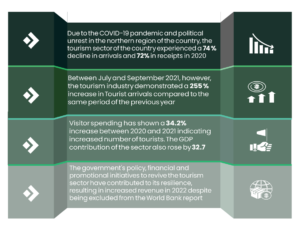
“The prospect of visiting Ethiopia attracted me more strongly than a trip to France, England, and America combined.” Nelson MandelaRich Culture, Advanced History, and Natural Wonders: UNVEILING ETHIOPIA Immersing in a land brimming with untapped investment opportunities in rich cultural heritage, ancient wonders, and breath-taking landscapes of Ethiopia has a captivating essence. Ethiopia, the cradle of East Africa’s oldest civilization and a country that has never been colonized, awaits a wealth of investment opportunities. From the mystical Rock-Hewn Churches of Lalibela to the majestic Castle of Gondar, from the remarkable Stelae of Axum to the captivating Walled City of Harrar, Ethiopia’s UNESCO-recognized tangible world heritages offer promising investment prospects. Various tourism investment opportunities are presented around the astonishing Tiya Stones, the captivating Lower Awash’s paleontological treasures, the vibrant Cultural Landscapes of Konso, the mesmerizing beauty of the Lower Omo Valley and its diverse tribes, and the awe-inspiring and majestic peaks of the Semien Mountains National Park. Beyond these tangible marvels lies Ethiopia’s vibrant intangible cultural heritage—holding massive investment potential. Vast investment opportunities await in the impressive Ethiopian Epiphany celebration, the age-old Gada system of governance, the joyous Fichee-Chambalaalla festival, the sacred Commemoration Feast of the True Holy Cross of Christ, and the vibrant Ashenda festival. Ethiopia’s rich Islamic heritage also stands as the oldest on the African continent. With remarkable historical sites like the Nejashi Mosque, dating back to the 7th Century and the tomb of the first and second Hijra migrants The Ethiopian Ministry of Culture and Tourism reveals the country’s historical and religious treasures. These ancient World Heritage Books include the Four Gospels/Bible from the 14th Century, St. Paul’s Epistles from the 15th Century, the Homily of the Passion of Our Lord, and the Services for Passion Week from the 15th Century, the sacred Book of Enoch from the 15th Century, the Psalterium Davids from the 16th Century, and the Letters from Ethiopian Kings to British Queens from the 19th Century Addis Ababa, the vibrant capital of Ethiopia and the epicentre of African diplomacy, has the African Union (AU) and the United Nations Economic Commissions for Africa (ECA) headquartered here, along with numerous embassies and international organizations. The city offers a strategic location for investment ventures INSIGHTS & FIGURES: ON ETHIOPIA’S TOURISM INDUSTRY In Ethiopia, the Tourism sector is among the high export income generating economic activities with the transfer of external funds and employing a significant number of workforces. According to World Travel and Tourism Council’s 2022 annual research, the growth of Travel & Tourism in Ethiopia was primarily propelled by international visitors spending. In 2021, International travellers accounted for 72% of the total Travel & Tourism expenditure, while domestic travel contributed 28%. From the 622 thousand total vistors, in 2021, the Ethiopia’s travel and Tourism sector saw significant contributions from leisure and business travelers. Business travelers accounted for 54% of the sector’s spending, while leisure travelers contributed the remaining portion. According to the World Travel & Tourism Council, the tourism industry made a substantial impact on the Ethiopian economy, contributing USD 4,229.7 million in 2021. This marked a 32.7% increase compared to the previous year. Further, the revenue from the sector constituted 34.3% of the total exports. In terms of the country’s overall GDP, the Ethiopian travel and tourism industry represented 5% in 2021. Tourism’s economic activity also played a crucial role in employment, supporting 1.56 million jobs, which accounted for 2.9% of total employment.. Despite the challenges posed by the global pandemic, the tourism sector demonstrated a notable growth rate of 4.5% in its contribution to employment between 2020 and 2021. This positive trend reflects the resilience of the sector and its ability to generate significant job opportunities. UNDERSTANDING MARKET DEMAND The Ethiopian Tourism ecosystem offers a diverse range of opportunities and attractions, including rich cultural and historical sites. Some of the demand indicators for the Tourism sector include the following 1. POST-PANDEMIC INCREASE IN TOURIST ARRIVALS & RECEIPTS
Following the pandemic-induced slowdown, Ethiopia has experienced a significant rebound in tourist arrivals and receipts, highlighting a revival and growing interest in the country’s tourism sector.
Ethiopia, in general, and the city of Addis Ababa, in particular, have been operation centres for more than 13 international hotel chains such as Hilton Addis, Marriot Executive Apartments, Sheraton Addis, Ramada Addis, Radisson Blu and Hyatt Regency to name a few.
According to the latest study by W Hospitality Group, Ethiopia is ranked 4th in terms of new hotel development, with 29 chain hotels and 5,206 rooms in the pipeline. Radisson Blu Hotel, Marriott International, Accor and Hilton are among the major brands expected to increase their presence in the country. Ethiopia has been in the top five countries on the list for the past six years.
As a result of the various upcoming star-designated hotels and speciality restaurants, the country’s capital, Addis Ababa, maintained the top three ranking for cities with large numbers of hotels and rooms planned in Africa for three consecutive years, following renowned tourist cities like Cairo.
Besides Addis Ababa, cities such as Dire Dawa, Bishoftu, Hawassa, Bahir Dar, Arba Minch, Gondar, and Adama have also seen remarkable hotel investment projects. These investments encompass luxurious hotels and resorts extending their services and footprint throughout the country. Notable mentions include Haile Resorts and Kuriftu Hotel and Spa.
 3. Expanding growth opportunities & market potential
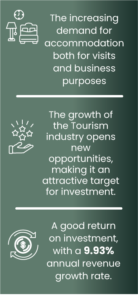
Investors should consider targeting the Ethiopian tourism market due to the growth in various segments
-
- Tour Operations
Tourist guides, travel agents, and tour operators offer promising opportunities. For instance, the booking market is expected to grow significantly. Targeting stopover tourists and business (MICE) tourists can lead to business growth. Providing integrated travel packages and creating a well-rounded experience can enhance revenue per passenger and attract more visitors.
-
- Vacation Rentals
Accommodation-sharing platforms such as Airbnb and Vrbo have disrupted the traditional hotel industry. The global vacation rental market is projected to reach USD 107.70 billion by 2027.
In Ethiopia, the vacation rental segment is expected to generate USD 334.70 million revenue in 2023, growing at an annual rate of 5.47%. There is a demand for localized and coordinated experiences, creating opportunities for specialized shared accommodation platforms.
-
- Campsites
Ethiopia’s campsites segment, especially in the southern region, offers investment opportunities in camping, lodges, and resorts. The camping sector is expected to generate USD 5.24 million revenue in 2023, growing at an annual rate of 46.85%.
The Simien Mountains National Park, Bale Mountains National Park, and Mount Yossef are already positioned as world-class destinations for high-altitude trekking, but there is a need to enhance tourism facilities and services, including expanded and upgraded camping sites.
-
- Tourism Tech Startups
Investing in Tourism tech startups can bring positive outcomes, as technology plays a vital role in ensuring a secure and smooth travel experience. Initiatives like 1888EC are actively developing digital solutions and fostering job creation within Ethiopia’s tourism industry.
Promising markets for Tourism tech startups encompass alternative housing, hotel and hospitality management, artificial intelligence, tours and activities, as well as diverse mobility sectors.
Overall, the growth in these tourism segments, coupled with the need for localized experiences, upgraded facilities, and technological advancements, makes Ethiopia an attractive market for investors. 4. Growth in MICE/ conference TourismThe MICE market (Meetings, Incentives, Conferences/Congresses, Events/Exhibitions) has become an increasingly important segment of the Tourism industry. Third, only to Brussels and Washington DC, Addis Ababa is home to 118 diplomatic missions accredited by the government of Ethiopia, the AU and the UNECA. As a result, the country hosts multiple international meetings and conferences every year.
The 2022 Annual Research Key Highlights from the World Travel and Tourism Council (WTTC) indicate that there has been an increase in business spending in Ethiopia during 2021 compared to 2019. This rise suggests a growing demand for services from business travellers and highlights the sector’s expanding contribution to the country and the country’s potential not only as a leisure but also as a business destination.
5. Future ForecastForecasts for the Ethiopian Tourism sector are optimistic about its future development. All tourism segments are displaying encouraging growth rates, with camping leading the way at a remarkable 46.85% increase, reflecting the anticipated interest of tourists in Ecotourism and adventure experiences through camping.
With its abundance of national parks, wildlife reserves, and mountainous terrain, Ethiopia possesses immense potential in the Tourism industry that remains untapped.
WHY INVEST IN ETHIOPIA? SUMMARY OF ADVANTAGES- Strategic geographic location in East Africa
A gateway to the region with easy access to neighbouring countries and a key transportation and logistics hub connecting Africa, Asia, and Europe
- Multiple UNESCO registered heritage sites
The country is home to 9 UNESCO World Heritage Sites, ranked 2nd in Africa.
- Addis Ababa, a significant diplomatic and political hub
Home to AU, ECA, and 115 foreign missions, making it the third-highest globally in terms of diplomatic presence.
- Ethiopian Airlines: Africa’s top carrier
Serving 131 international passenger and cargo destinations, including 63 African cities, flying to more destinations in the continent more than any other airline.
- Market ready product offers including meeting venues and hotels
More than 600 hotels with more than 13 chain hotels and more in the pipeline. World-class large conference venues at the AU, UNECA, and AAICEC
- Secure country with World Trade and Tourism Council (WTTC) Safety and Security stamp (2021)
In 2021 the country has received WTTC’s Safety and Security stamp, indicating that the country follows global standards to ensure the well-being of tourists and visitors.
- Tourism is one of the priority sectors that the Ethiopian government granted tax exemption & incentives
Specific details of the tax exemptions and incentives can be seen in the next section
- One stop shop service delivery for investors by the Ethiopian Investmen Commission
EIC facilitates investment procedures, offers guidance, and assists investors in navigating the business landscape in Ethiopia.
- Simple E-visa application and nearly 40 visa on arrival eligible countries
- Continuing efforts to digitalize the travel & hospitality industries to increase convenience & competitiveness
Hotel and resorts Tour operation Cultural festival and events Adventure retreats and camps Adventure sport facilities Adventure tour operation Helicopter and hot air balloon safaris Rural accomodation and homestays
Farm tours and farm stay packages
Vacation Rentals and lodges
Premier accommodation with packages
MICE facilities and convention centers
Professional conference organizers
Stopover packages and experiences
Stopover lounges and experiences
Stopover travel apps and digital services
Sports tourism package
Sports training facilities
Sports training program
Halal-Friendly Accommodations
Halal Culinary Experiences
Islamic Heritage Tours
Halal certified spa and wellness services
Eco-lodges and Sustainable Accommodation
Developing adventure eco-tourism activities
Nature-Based Guided Tours and Activities
Geotourism infrastructure
Geothermal Tourism
GeoTourism Guides and Services
Geoparks and interpretive centres
 OPERATIONAL REQUIREMENTS
Businesses in the Tourism sector, such as tour and travel agencies, hotels, and accommodation operations, need to acquire Investment, Business, and Competence Certificates.
Investment activities eligible for Tourism sector incentives include duty-free importation of capital goods, construction materials, spare parts (up to 15% value of capital goods), and limited types and numbers of vehicles. These incentives apply to star-designated hotels, motels, lodges, restaurants, and tour operations. The essential service processes an investor goes through are outlined on the next page.
Ethiopian investment law specifies the Tourism sectors that are reserved for domestic investors and open to foreign investors.
 LICENSING PROCESS FOR FOREIGN INVESTORS
 KEY STAKEHOLDERS IN TOURISM INVESTMENT